News
Published October 12th
From tomorrow, October 13, until Sunday, October 18, we look forward to presenting Im Fell for the first time — a piece for young audiences created in collaboration by Ulrike Kley and Isabelle Schad, at Schaubude Berlin.
What does fur sound like when it brushes over the ground?
How heavy is fur? And can it fly?
And what appears when a person disappears into fur?
Fur grows, rustles, protects and plays. It is heavy and light, a shell and a hiding place, an animal and a landscape. A body appears within it and disappears again.
Between furs, a wordless world of hiding, appearing and transforming is created – warm, dense and willful, until something suddenly comes to life.
All performances are designed as relaxed performances.
More Info: here
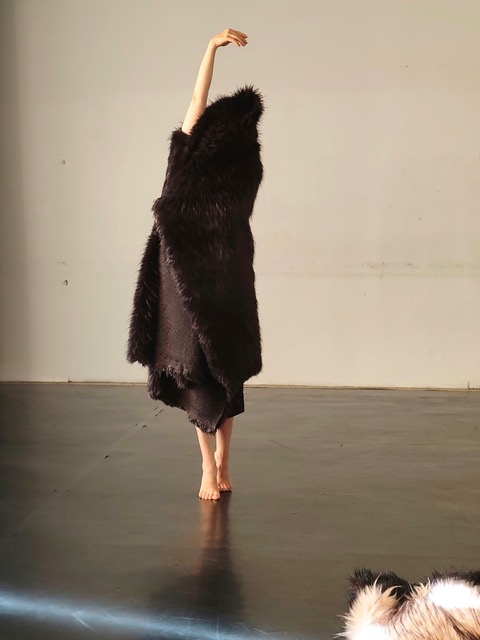
Photo: Isabelle Schad, all rights reserved
Published 10 September 2026
An intense weekend of experimental formats and exciting collaborations in Berlin is about to begin.
We start with Fluid Matters, a transdisciplinary work by Nora Mertes and Isabelle Schad, presented at Hošek Contemporary on 11 and 13 September. (https://www.hosekcontemporary.com/)
In between, as part of our invitation from Stadt Land Panke Festival, we will present Moment Forms / Hands Dances at Richten25 on 12 September — a performance for dance and saxophone by Isabelle Schad & Chris Pitsiokos. (https://richten25.de/events)
We hope to see you!
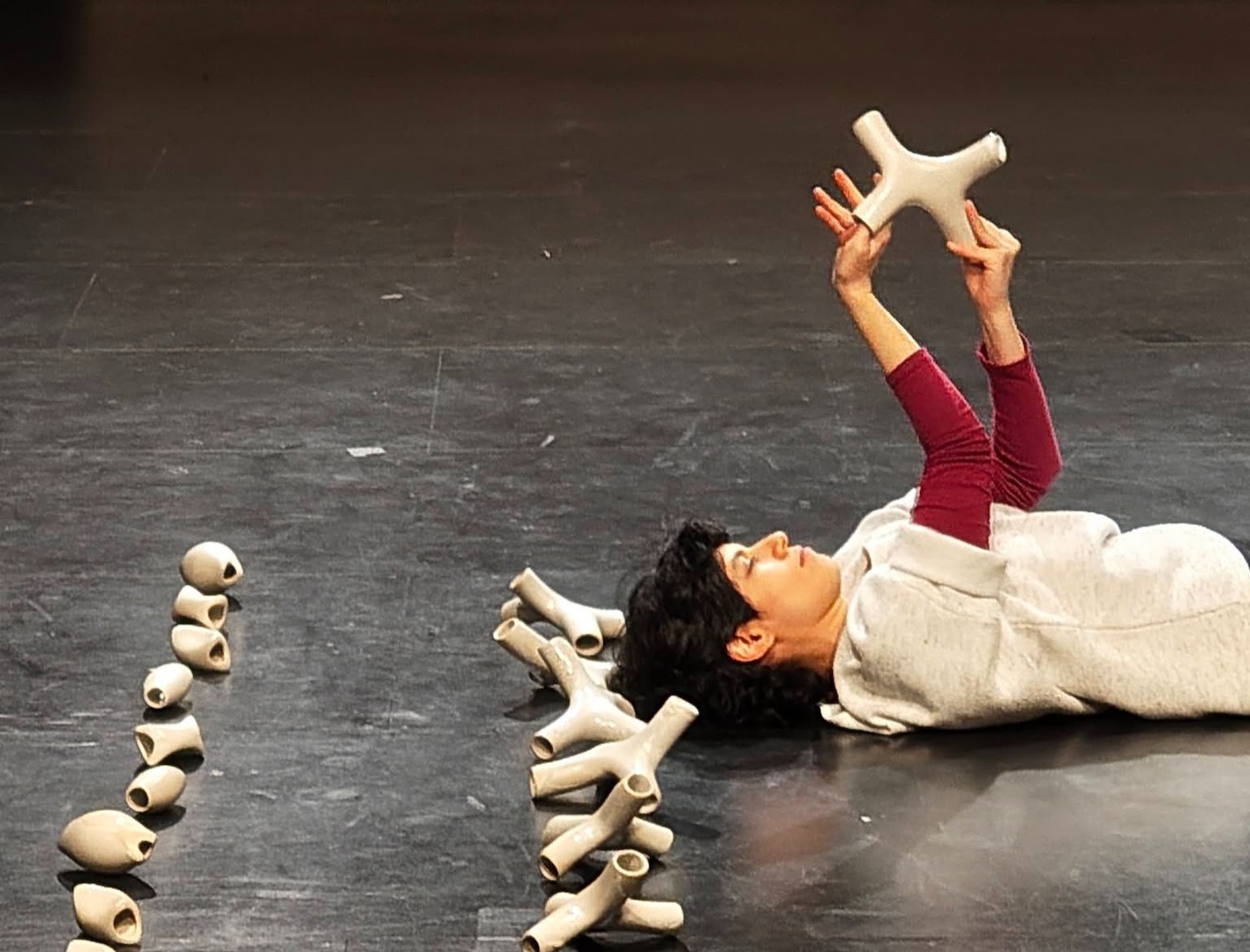
Fluid Matters, Photo by Isabelle Schad, all rights reserved
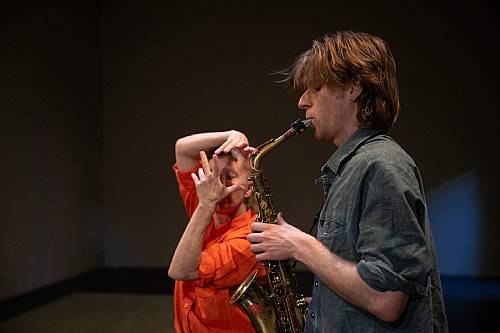
Moment Forms / Hands Dances, Photo by Dieter Hartwig, all rights reserved
Published 27 July 2026
Next week August 6-8, we will present Studies on Infinity – Nudity and Landscape at the Uferstudios in Berlin.
COME AND JOIN US!
” The naked body is the fastest cut through fiction. No costume, no symbol, no character—just being. That is where nudity can be political—not because it is provocative, but because it removes all protection. Barriers. The naked body is vulnerable, but also radically present. And presence is what matters most in as much as it shares our ground and brings us together.
If a naked body triggers objectification, it is because our gaze as a society is damaged—not because the body is naked. In this work the attempt is to return to nudity as a practice of de-objectification. When we watch a body that moves, breathes, contracts and expands as a process, it becomes impossible to reduce it to an object. It becomes a relation, and the whole self is present.” IS
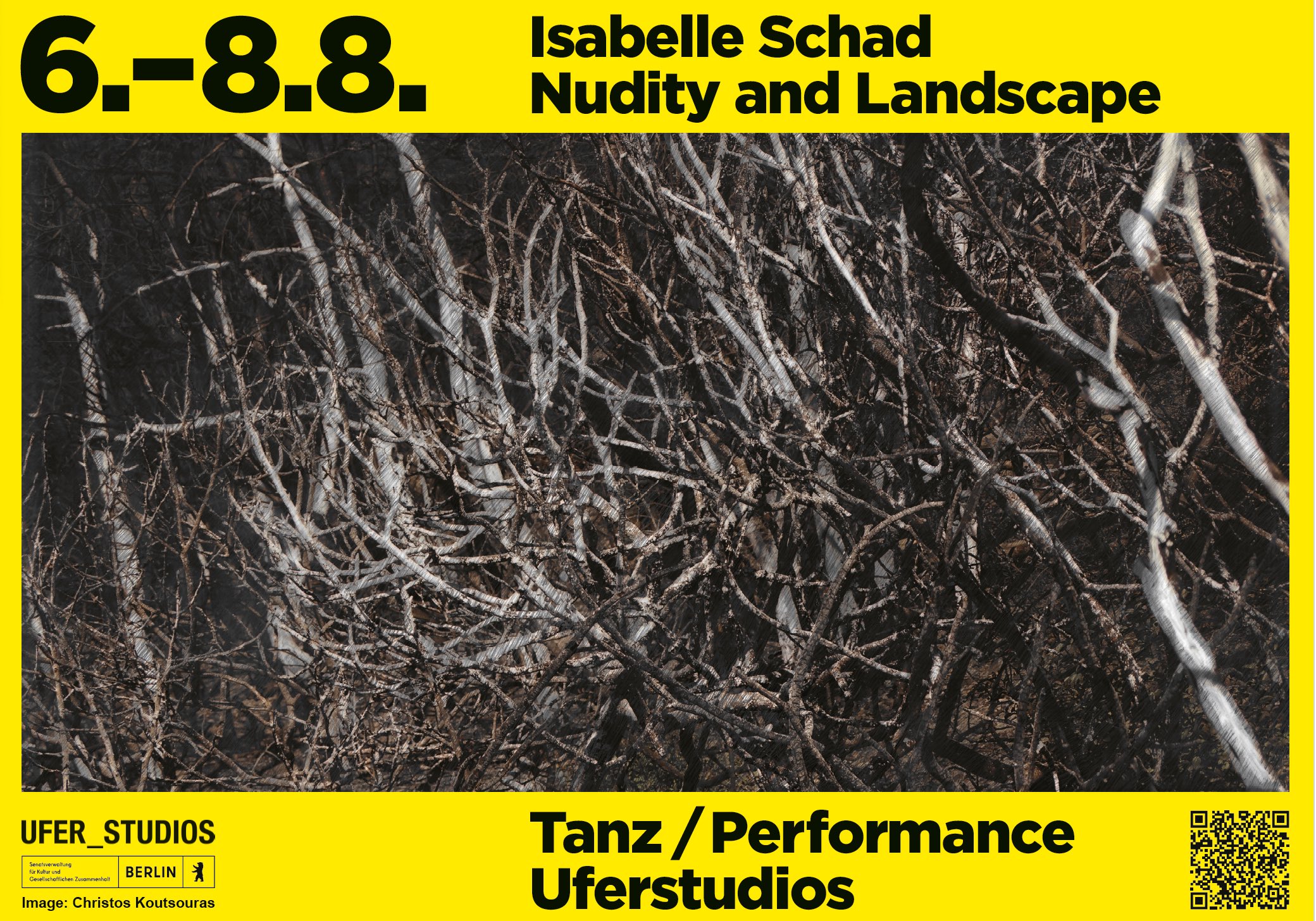
WANN / WHEN
6. August, 19:00 Uhr / 6 August, 7 pm
7. & 8. August, 20:00 Uhr / 7 & 8 August, 8 pm
WO / WHERE
Uferstudios – Uferstudio 14, Uferstraße 23, 13357 Berlin-Wedding
TICKETS
„Pay what you can“ Preissystem / pricing system (10 | 15 | 20 €)
https://www.uferstudios.com/de/home/
CAST & CREDITS
Concept & Choreography: Isabelle Schad
Co-Choreography & Dance: Johanna Ackva, Viviana Defazio, F.F., Veronika Heisig, David Kummer, Yen Lee, Jan Lorys, Arantxa Martinez, Lea Pischke, Aya Toraiwa, Nir Vidan
Composition & Sound: Damir Simunovic
Lighting Design: Bruno Pocheron
Voice Work: Ignacio Jarquin
Social Media: Rike Nölting
Communication: Elena Basteri
Production Management: Heiko Schramm
Photo: Urska Boljkovac
Supported by the Senate Department for Culture and Social Cohesion of the State of Berlin.
Published 1 July 2026
Three questions to Isabelle Schad about Studies on Infinity #4 (Drumming & Rescue Score)
Elena Basteri: Studies on Infinity has evolved into an ongoing exploration of movement over the past four years. How has your understanding of the concept of infinity changed throughout the process?
Isabelle Schad: Actually my ideas around the notion of infinity haven’t changed that much.
Studies on Infinity serves as a concept for looping materials in variations, potentially as long as our energies last – as long as we can stay present and as long as the overall schedule within our Sommerfest.ival permits. The idea is to dive into the choreographic materials, into our movement and sound principles, and mould them by repeating them. Looping our sketches deepens our understanding of them. Materials become materialities, and we lose the notion of linear time.
Infinity can thus relate to time – timeless experiences – but to space as well. The spatial tensions that create infinite prolongations of one into another are important in as much as they organise our space and our spacing. We look at each other as if mirroring ourselves in one another, which creates an infinite feedback, and this is also relevant as a relationship to the spectator, who becomes another mirror. As if the whole world were a mirror of our selves …
EB: Music plays a central role in this new iteration, with a live performance by the musician and composer Anders Vestergaard. How did this collaboration come about, and how do music and movement shape and influence one another within the work?
IS: Chris Pitsiokos organised an experimental music festival at our place Tanzhalle Wiesenburg – the Hard Listening Festival. I went by several times during the festival, and I was blown away by the quality of the different events and concerts. Anders Vestergaard played a solo drumming concert which was a real shock for me. It was musically so intense and so joyful, and it was a brilliant movement performance at the same time. Seeing him play was like seeing dance, dance in trance, qi gong or aikido to me. I instantly visualised movement, and dreamt of working with him and this music. The first idea that came to my mind was the power of music, the power of dance, the power of being fully present where we are and through our respective artistic means.
The live performances during the festival with Chris on alto saxophone were equally fascinating to me, by the way. After speaking with one another, different openings and wishes for collaboration popped up. With Anders the power of percussion, rhythm and layers of live-triggered resonances are at the centre our new research. The spatial tensions and the power of the sound crossing the space and hitting the walls, the sound-waves riding across, affects us a lot, and it affects us differently in different places in the space. The aikido practice that I’ve been involved with for many years teaches us to send out energy and a fluid soft force that can’t be achieved through muscular strength. It’s another strength, that of permeability. And it’s the one that sends out forces and energy as a soft yet powerful strength. Anders does the same with his instrument and in his way of playing it. So I have the feeling we can amplify one another, sound and music, movement and dance, and have a third thing generated by playing with one another.
We’ve started a collaboration with Chris too – an alto sax and dance duo on the concept of Hands Dances, which is a format I invented two years ago as an answer to the cultural funding situation with all the cuts, frustrations and diminishing hopes. The concept is orientated to the freedom of a musician, who takes his instrument to play for people, and lots of communication happens. Why don’t we do something like that in dance? Why don’t we dance more? I thought we needed to free ourselves from production burdens and act much more like musicians … and take our physicality as an instrument further, in a humble way, and let our hands speak and dance like those of a musician. We’re showing some results of this research here in the festival too.
EB: In the performance text you speak about creating spaces for resilience, hope and collective experience at a time of social and global crisis. What role can dance play today in cultivating these qualities and responding to the challenges of our time?
IS: We’re living in extremely brutal times of capitalism and individualism. And the crises are on all levels – there are the wars, of course, but we’re also experiencing dangerous right wing movements, populism, constant polarisation in communication, extremely cruel migration politics that don’t respect human rights. People are brought towards fear and compelled to act out of fear. It’s really frightening.
We need to do everything we can to live our lives with respect for one another, with a peaceful and loving mind and with a deep acceptance for one another and our differences. Respect and acknowledgement are the basis for any democratic way of being with one another rather than against one another – the one and the other, the foreigner as a frightening other, which is just the metaphor for war. In our daily practice, which is strongly influenced by aikido, I feel the emphasis is less on the movement itself, or on any notion of perfection, than on the quality of attention devoted to what we are doing. The attention guides the hands, the movement and the action we’re carrying out. This alertness – this attentiveness – also includes bowing and respect for the other. It naturally brings with it mindfulness, a sense of safety and compassion.
Presence in the moment also gives rise to an awareness of impermanence, because you recognise that movement and transformation are always taking place already. This in turn evokes a certain reverence for life. You realise you’re part of larger movements and interconnections rather than standing above them. Serving is an art in itself. We can serve someone, a community or a bigger whole, It’s an art in itself, and this is so different from just taking and consuming.
I would even argue that the alertness and attentiveness I’m talking about also contain the capacity to serve. Perhaps it’s worth reflecting more deeply on the notion of service: serving oneself, serving others, and serving the community as something of great value – as an art. As a unique mode of experience and as an honour bestowed on us during our lives as human beings, as creatures whose very nature is rooted in community.
I think group work – and in this context we’re a small group, though we can also be many – is a proposal for a WE with our differences and uniqueness, our singularity and the energy each of us brings. The two scores we use in this context reflect the power of expression through our respective media of dance and music. The drumming score is organised like a game of chess, and the rescue score deals with the notion of HELP: rescue and its transformative potential.
Published 18 June 2026
Next week, on June 26 and 27, we premiere Studies on Infinity #4 (Drumming & Rescue Score) as part of Sommerfest.ival 2026 at the Tanzhalle Wiesenburg (see details below). Alongside it, two new iterations of Hands Dances will be presented. For this occasion, Isabelle Schad and Chris Pitsiokos (alto saxophone) will perform together, as will Maja Zimmerlin and Johannes von Buttlar (drums).
Throughout the festival, the Tanzhalle Wiesenburg and its beautiful garden will come alive with performances, concerts, talks, and many other encounters. Check the programme here.
We look forward to welcoming you there.
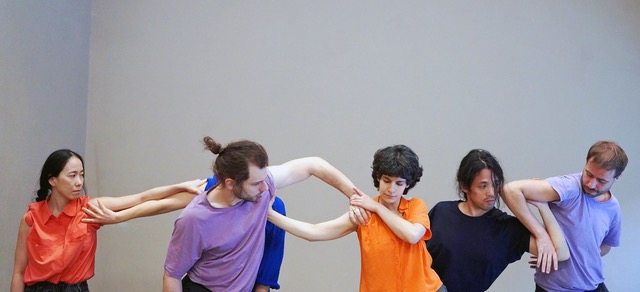
With Studies on Infinity #4, Isabelle Schad continues her long-standing research on movement materials and their potential to unfold in infinite variations and interconnections. This time, the work centers on the question of how, through and with our respective media—dance, sound, voice, and music—we can create spaces for resilience, hope, and collective experience, especially in times of social and global crisis.
The starting point is a movement practice developed over many years, combining somatic techniques with principles of Aikido and the spirit of Zen, and continuously refined in collaboration with the members of the Mobile Ensemble.
The collaboration with musician and composer Anders Vestergaard expands the choreography through a powerful percussive dimension, intensifying the bodily and musical resonances, forces, and relationships within the performance. The resulting material will be presented for the first time in an intimate and open setting composed of miniatures and loops.
WHEN: June 26, 6:00 pm & June 27, 5:00 pm
On both days, a sensory introduction with Isabelle Schad and the performers will take place 30 minutes before the performance begins.
TICKETS: Pay what you can (recommended donation 5-20 €)
CAST & CREDITS
Concept & Choreography: Isabelle Schad / Co-choreography & Dance: Aya Toraiwa, Jan Lorys, Forough Fami, Claudia Tomasi, Isabelle Schad (26.6), Yen Lee (27.6) / Composition, Live-Performance, Drums: Anders Vestergaard/ Costume: Michael Sontag / Light Design: Bruno Pocheron / Voice Coaching: Ignacio Jarquin / PR, Outreach: Elena Basteri / Production Management: Heiko Schramm
Production: Isabelle Schad / Funded by: Senate Department for Culture and Social Cohesion of the State of Berlin / Supported by Wiesen55 e.V.
Published 27 April 2026
We are happy to share this conversation between Isabelle Schad and writer Lucie Kocourková about Pieces & Elements in Prague (and much more), which was published last week on https://divadelni.net/
ISABELLE SCHAD: BY BEING CLOSER TO ONE’S OWN SELF, YOU BECOME CLOSER TO THE OTHERS
This year, the Bazaar Festival, international showcase of progressive stage works by theatre and dance innovators who maintain a healthy distance from official culture and are unafraid to take risks, presented the work of the renowned German choreographer Isabelle Schad for the first time. The creation Pieces and Elements was presented as opening performance of the 12th edition, in line with this year’s theme of human and non-human communities through a collective body in motion. We had the opportunity to ask the choreographer a few questions not only about this piece of hers, but also about her broader artistic inspiration—which might inspire you as well.
Lucie Kocourková: The programme says: “A group of dancers creates an organism that can only exist as a whole. The body becomes a site for creating community, in which each element is an integral part of the collective being.” Do you personally perceive society as a single collective organism? What role does individuality (the individual) play within it?
Isabelle Schad: Society is a complex system where power and control unfortunately play as much of a role as our desire for democratic rights, values and mutual respect, for which we constantly need to re-organize ourselves or fight for. With my trilogy on collective or group bodies, I have been developing scores and materials inspired by utopian ideas of a potential society – around how we could possibly function together as a whole, in which every part relates to every other one, every limb to the next one, as if each part of the body would be a performer. In Pieces and Elements, I took inspiration from nature, from the 5 elements (being water, wood, fire, earth, metal) that create an infinite cycle of reproduction and nourishment.
LK: Pieces and Elements (2016) are the middle part of the trilogy. The first one, Collective Jumps (2014), explored the body as a site for creating community. What theme did the third part explore?
IS: The trilogy has been finished in 2019. The last part, called Reflection, has been made for a theatre with a turning stage. I am dealing with the forces of the stage apparatus as a way of a bigger force that is (also in society) controlling us. It is lot more about the protagonist, the hero or victim that can be each of us within a group or a larger whole…
LK: Why did you begin to explore the phenomenon of collective bodies?
IS: I simply love working with groups. When I share my practices based on body work, somatics and the martial arts Aikido, people start to connect without losing themselves. They strengthen each other by strengthening themselves: by being closer to one’s own self, you become close to your neighbour, to one another and you start to be more present and active in the world as well.
LK: If we look at the topic through the lens of the present, many “organisms” within the society are in motion today. The individual is part of a larger body; thus, to a certain extent, they are controlled by it, flowing with the current because they are dependent on it – and if they leave it, they perish. The artist-creator, on the other hand, is someone who creates and expresses themselves primarily as an individual. How do you seek and define your position within the collective body?
IS: The work starts with the self – with one-self. Every single one of us needs to find at first a way to get calm, with a quiet mind and present; it is by being with an empty mind that you are able to perceive yourself as a whole and in the whole (space), and from there actions – as much as movements – express themselves in a clear and decisive way. It is so much more political – being in such a practice – than anyone not starting from such a point of departure could believe.
Maybe it is a holistic approach (more related to eastern practices such as Tibetan monk than to the individualized western ones), but it is the one that strengthens us as a group as well as every single one of us being part of this group.
LK: You already mentioned the 5 elements, which the programme also referred to: how do they manifest in movement? What drew you to these principles of elements?
IS: I have been studying Shiatsu at the time, which is a Japanese massage technic that follows principles of TCM (Traditional Chinese Medicine) such as the 5 elements, where one element nourishes the next one: water gives growth to plants (wood), they are the food for fire, burning the wood transforms to earth, earth contains minerals (metal) which become particles in the water and then it starts again. Those 5 elements also relate to 5 seasons (winter, spring, summer, late-summer, autumn and winter again), to ages (birth, young age, adolescence, grown up, old, wise old to die… and it starts again) or to organs and meridians. Basically, it is at the same time a complex and simple system. You really need to study, and of course experience it, and it is a system of transformation. I found it fascinating – it is now 10 years ago (already!) that I have been creating this piece in relation to that approach and practice!!!
It has been not at all a symbolic approach but on the contrary, a very concrete one: we have been studying the meridian stretches that are all finding themselves – in one way or another – inside the choreography, the corresponding Qi-Gong exercises, the qualities related to the different organs, seasons etc… It is a bit long to explain by interview… It’s the process of practicing, training and building choreography from there!
LK: What do the Asian movement techniques and practices offer you, or the Western person in general?
IS: I think I have answered the question already in my answers before, but maybe I could add this: Asian practices such as Shiatsu and Aikido have something in common which is much less about a specific intention. They are done daily and stand for themselves. It is not that you don’t want anything, but you do not want to force on something specific to be achieved. You believe in its worth as such and that doing them on a daily basis offers that certain pathway – the aiki-DO, and ‘DO’ means pathway – that you agree to go along. It is not about quick achievements, but on things you do regularly and in a certain stoic way…
LK: What specifically can they offer a practitioner of the performing arts or a choreographer?
IS: I think those practices offer us clarity and a calm and quiet mind that makes us able to perceive ourselves as a whole within the whole.
LK: In post-dramatic (dance) theatre, ambiguity is normal, even desirable. As the author, do you have a preference for how you want your work to be “read,” or do you prefer that viewers form their own associations and interpretations? If the topic has a societal or social impact, perhaps you’re looking for a specific reading?
IS: No. No. I am interested in making everyone be part of a journey and of this perception of the whole, so that ideally your own stories, your own life or experiences are reflected, are mirrored or passing through, by, along… I would like people to relax with us, to enjoy, to dream, to get lost or anything else that happens to them…
LK: A colleague of mine described the experience in one part of her review as meditative. Does that align with your intention?
IS: Yes, this can be one notion…
LK: I learned that you originally studied classical dance. You began your career as a professional dancer: did it fulfil or disappoint you?
IS: It fulfilled me till I wanted to change… But it is still part of me, too.
LK: Why did you choose the path of contemporary dance then? I don’t think that’s typical if one is trained in classical dance. It usually is a long way to even accept the contemporary language as real dance and a huge path to find pleasure and meaning in it.
IS: I have had a long transformation process, a bit too long to explain here, but basically, I have refused to copy or reproduce ways to move as… like styles… but instead I have searched for ways to move with or move from. To find the origins of movement from within ourselves I understood from the moment I have studied Body-Mind Centering. Moving from your cells, your body systems such as organs, bones or your skin, has been completely different to copying a form. It is about what “in-forms” a form.
LK: How do you think classical technique manifests itself in your work? Personally, I’m convinced that it’s a language the body never forgets – even if one wants to – because it has been internalized as one’s own.
IS: It is the urge to create logic lines and diagonals, logic forces through your body, which create a universal sense of beauty.
LK: Your works oscillate between dance and visual art, between performance and installation. Where did the influence of visual art on your work come from?
IS: Working with Laurent Goldring, visual artist based in Paris has been a strong impact on me and my – or also our common – collaborative work. It started roughly in 2008 or 9 with a solo entitled Unturtled. We have worked with a body covered up in oversized clothes as a means to amplify, rather than hide, what’s inside this body: fluids, ligaments, bones and other systems of the body I have mentioned earlier on.
LK: So, you consciously draw inspiration from visual art?
IS: Yes, I do.
LK: Do you have any ties to the Czech dance scene?
IS: No, but now yes, and I am very proud and happy about having been presenting my work here. Ewan has seen my performance installation Nudity and Landscape in Ljubljana last November and we have been in touch since then.
Now I just remembered that I have made this piece The Burrow in collaboration with Laurent Goldring. It is a solo we have created together in 2012 as a prolongation to our first collaboration Unturtled, and it has been inspired by Kafka’s short story The Burrow (Der Bau), where an animal’s burrow is described as a metaphor, a space deriving from the body itself, yet still belonging to it – bearing the form, traces, odours, wastes and reserves, hope and despairs… – and it seemed a good basis for further explorations of conceiving this new relationship between body and space… I found it funny, as Prag is the “city of Kafka”.
LK: If I’m not mistaken, you’re the co-founder of Tanzhalle Wiesenburg. I’d be interested to know how dance venues in Germany are faring these days. How broad is their audience base, and what’s the situation with funding…
IS: The funding situation is terrible right now, but what helps us continue is self-organization, solidarity and continuity. Luckily, we (as a group around Tanzhalle Wiesenburg) are still receiving funding, and as a choreographer I am also lucky enough to be part of the funding system. But cuts are being made and it concerns and hits all of us, in one way or another, we feel it. And we go on the streets, stick together like a big rubber band – of solidarity. And that’s really strong and beautiful.
LK: Thank you for this hopeful conclusion and for being part of the festival.
Published 24 April 2026
Showing Pieces and Elements in Prague at Bazaar Festival has been a wonderful opportunity to meet an enthusiastic and engaged Czech audience and press. We are thankful for the many reviews and interviews by insightful writers whose thoughts, questions, and reflections on the work have highlighted its strong resonance with today, even after 10 years…
Thank you so much tho the whole team of the festival for making this happen!
All the articles can be read in the “Press” section of Pieces and Elements by clicking here.
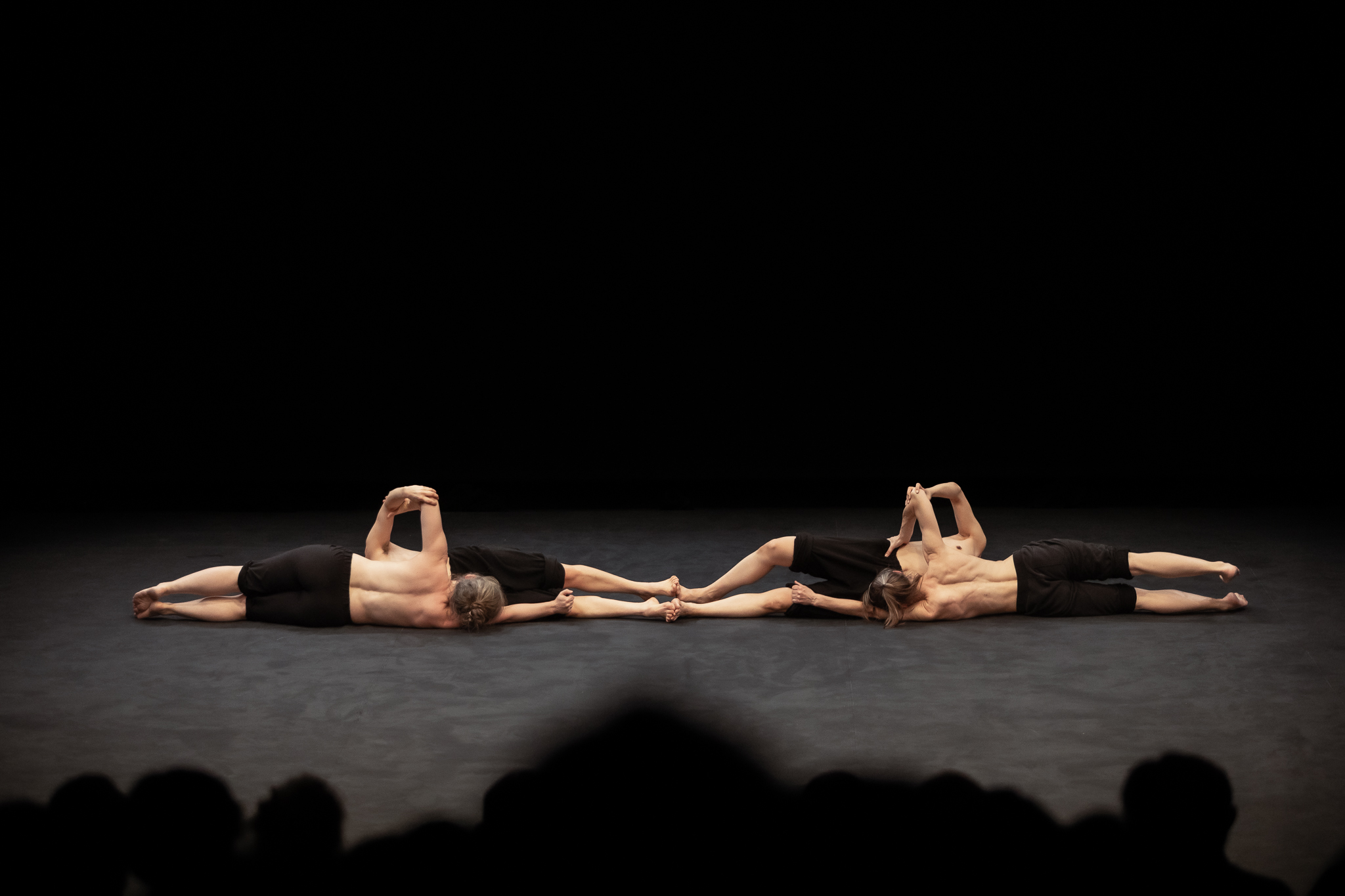
Photo by Dan Kvapil, all rights reserved
Published 10 March 2026
We are very happy that Pieces and Elements has been selected to open the Bazaar Festival in Prague on March 12.
The focus of this year’s edition — dedicated to human and non-human communities — offers a meaningful framework for re-presenting a work that considers phases of transformation and nature as potential energetic means of becoming one: as a body, a self, or a group.
All Info and Tickets here: https://www.bazaarfestival.cz/en/
 Photo by Gerhard F. Ludwig, all rights reserved
Cast & Credits
Concept und Choreography: Isabelle Schad; Co-Coreography: Jozefien Beckers, Frederike Doffin, Johanna Ackva, Yen Lee, Manuel Lindner, Jan Lorys, Claudia Tomasi, Aya Toraiwa; Sound: Damir Simunovic; Light Design and Technical Direction: Bruno Pocheron; Costume: Charlotte Pistorius; Production Management: Heiko Schramm; Production: Isabelle Schad; Co-Production: HAU Hebbel am Ufer.
Supported by the NATIONALES PERFORMANCE NETZ International Guest Performance Fund for Dance, which is funded by the Federal Government Commissioner for Culture and the Media
Published 20 January 2026
Purple – the International Dance Festival for Young Audiences is celebrating its 10th anniversary this year, and we are grateful to be part of the rich festive program with Yuki Onna – Die Schneefrau, to be presented January 23–25 at our partner and co-producer Theater o.N.
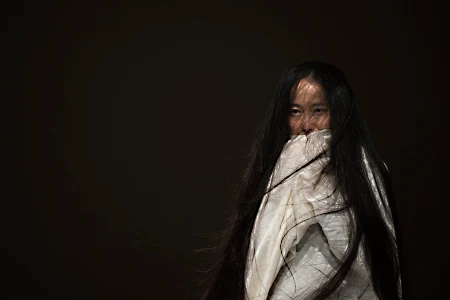
Photo by Dieter Hartwig, all rights reserved
Published 25 November 2025
We are delighted to present Studies on Infinity #2 – Nudity and Landscape at the 14th edition of CoFestival in Ljubljana, tomorrow, November 26.
It is a privilege to return to this distinguished international platform for contemporary dance and to share our work once again in such a vibrant and inspiring city.
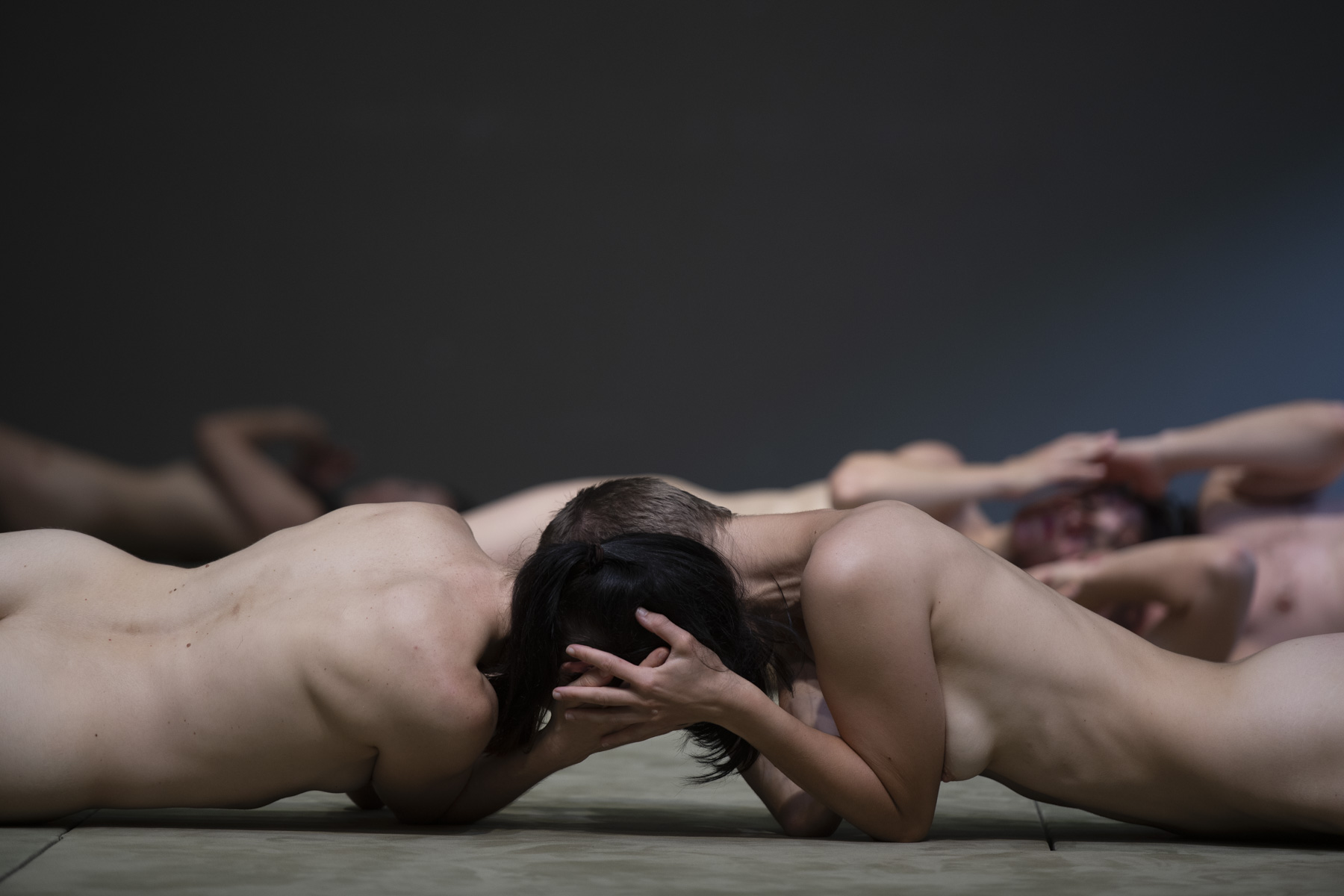 Photo by Dieter Hartwig, all rights reserved
“The continuation of skin from one body to another corresponds to an understanding of the self as extending/mirroring infinitely through others and the environment. It is an energetic principle that follows the law of attraction: a mirror reflects back, vibrates and attracts what is sent out. We are all infinitely reflecting and being reflected.”
— Isabelle Schad
CREDITS
Concept and choreography: Isabelle Schad
Co-choreography and dance: Johanna Ackva, Viviana Defazio, F.F., David Kummer, Yen Lee, Manuel Lindner, Jan Lorys, Lea Pischke, Aya Torawa, Maja Zimmerlin
Composition and sound: Damir Simunovic
Lighting design: Bruno Pocheron
Voice work: Ignacio Jarquin
Communication: Elena Basteri
Production management: Heiko Schramm
Production: Isabelle Schad
Funded by: Senate Department for Culture and Social Cohesion of the State of Berlin
Supported by: Wiesen55 e.v
Published 19 November 2025
This Saturday, November 22, we will bring HANDS DANCES to Hannover as part of the Musik 21 Festival.
HANDS DANCES is a format for the transmission of practice conceived by Isabelle Schad in 2024. It is a choreographic tribute to the agility and functionality of hands as well as a celebration of the sensory perception of the world through music and dance.
The upcoming iteration emerges from a dialogue between Isabelle and Ehsan Khatibi, between four dancers/choreographers from the Mobile Ensemble, four composers and four musicians from Ensemble L’ART POUR L’ART.
Credits
Choreographic Concept: Isabelle Schad
Dance and choreography: Aya Toraiwa, Forough Fami, Yen Lee, Johanna Ackva
Composition: Irini Amargianaki, Oxana Omelchuk, Francisco C. Goldschmidt, Francesco Ciurlo
Ensemble L’ART POUR L’ART: Astrid Schmeling – flute; Teresa Grebchenko – percussion; Uschik Choi – violoncello; Ulf Mummert – electric guitar
Dramaturgy and Artistic Direction Team: Isabelle Schad, Ehsan Khatibi
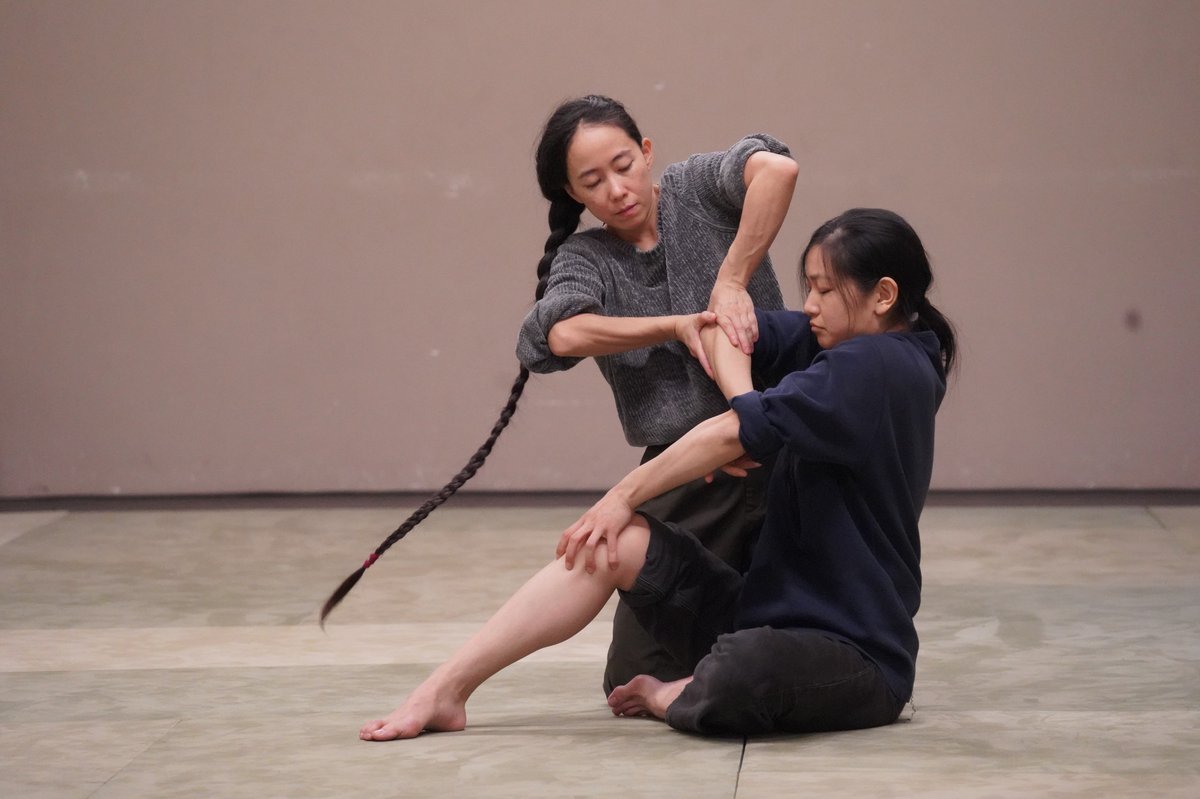
Photo by Isabelle Schad, all rights reserved
From left to right: Aya Toraiwa, Yen Lee
Published 4 November 2025
Thanks to the support of Offensive Tanz, we are delighted to present Yuki Onna – Die Schneefrau, once again next week at Tanzhalle Wiesenburg.
As the days grow shorter and darker, Aya Toraiwa – our Queen of Snow – will guide you into the magical world of this winter fairy tale, filled with shadowy realms and hypnotic moments.
A mysterious and enchanting landscape awaits audiences aged 4 and above.
WHEN: Thursday 13.11 & Friday 14.11.
WHERE: Tanzhalle Wiesenburg, Wiesenstraße 55, 13357 Berlin
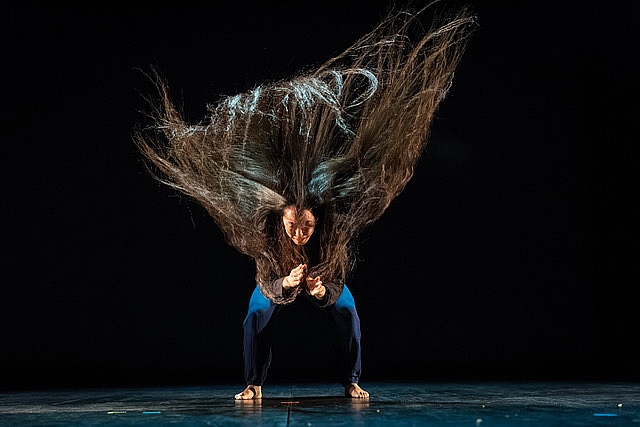
Photo by Kay Herschelmann, all rights reserved
Published 7 October 2025
After a moving tour through India, Harvest — a performance for audiences of all ages — returns this week to its place of origin, the Tanzhalle Wiesenburg, with shows running from Thursday to Sunday.
We would be happy to see you there!
WHEN: Thursday 9.10., Friday 10.10. Saturday 11.10., Sunday 12.10.
WHERE: Tanzhalle Wiesenburg, Wiesenstraße 55, 13357 Berlin
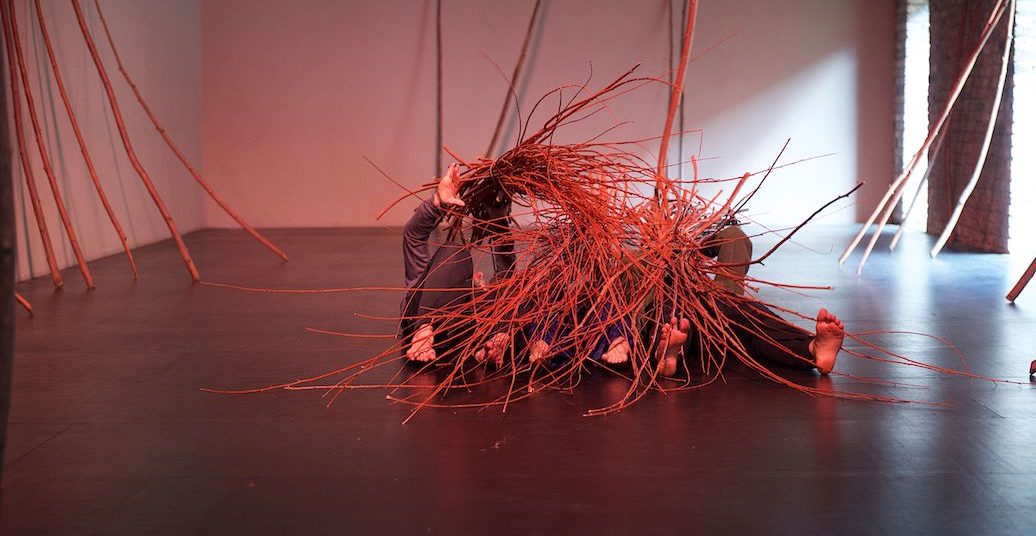
Photo by Dieter Hartwig, all rights reserved
Published 2 September 2025
To celebrate the 100th anniversary of the Bauhaus moving to Dessau, we will be part of the rich artistic program curated by the Bauhaus Dessau Foundation, under the title An die Substanz.
On September 5th, we’ll be presenting a new performance inspired by Bauhaus artist and choreographer Oskar Schlemmer. Taking his iconic geometric forms as a starting point, we explore a more fluid and mobile composition made of bodies and shifting costume elements. We’re fascinated by how movement can transform materials—and how these transformations can open up space for poetry and sensory perception.
Concept, choreography & performance: Isabelle Schad & Manuel Lindner
Costume design: Michael Sontag
Lighting: Bruno Pocheron
Sound: Damir Simunovic
With the support of Wiesen55 e.V.
Come join us in Dessau!
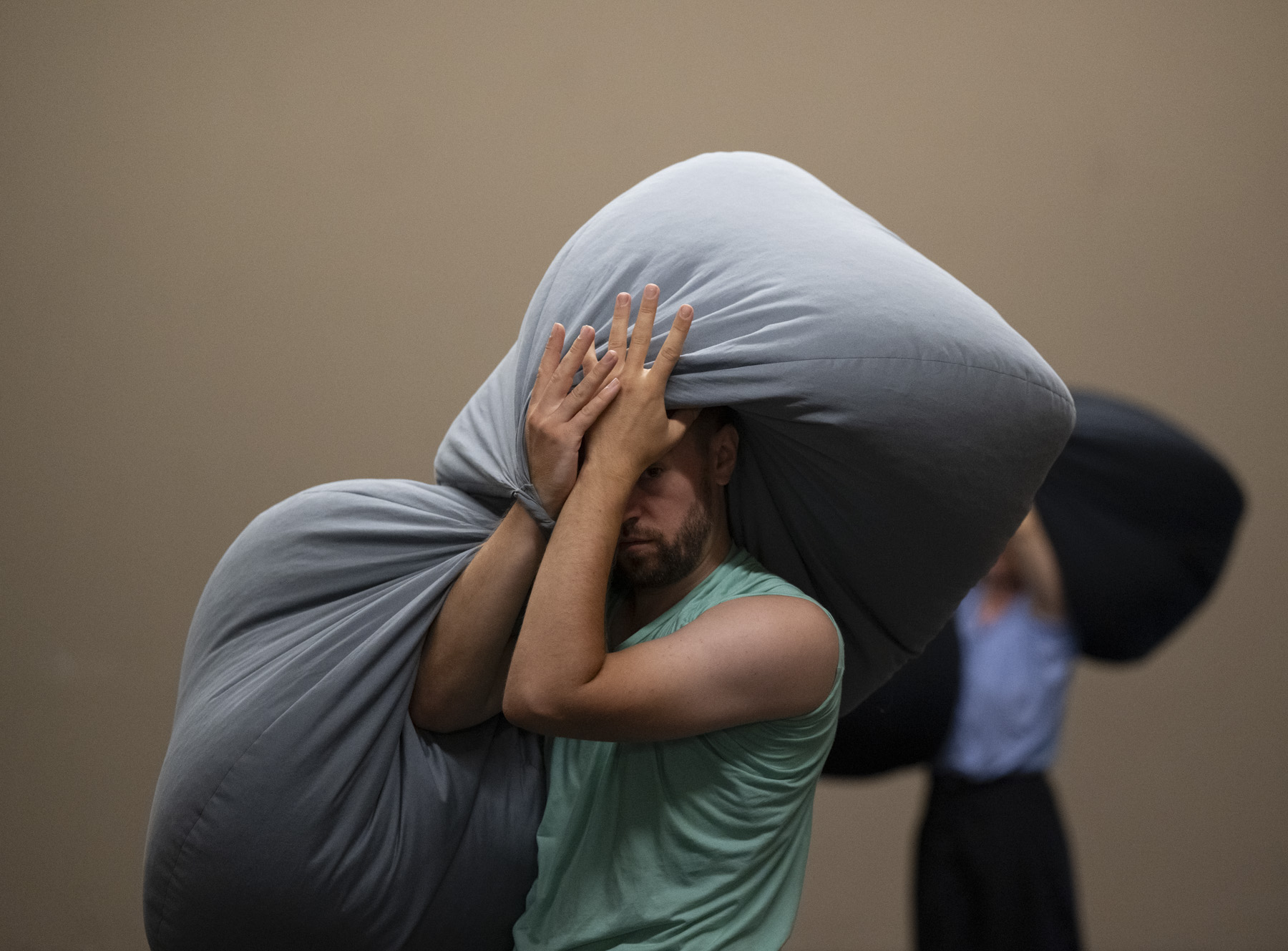
Photo by Dieter Hartwig, all rights reserved
Published 18 July 2025
We are thrilled to share that we have been ranked second in Tanznetz’s brand-new critics’ survey on artistic developments in the 2024/2025 season.
The survey examined eight categories, including choreographers, dancers, companies/ensembles, choreographies, venues, behind-the-scenes personalities, festivals, and institutions for dance education.
We are deeply honored to be recognized among the most frequently mentioned choreographers of the season, particularly for Bodies of Lights with Claudia Tomasi and Yen Lee, and for Mirroring with Josephine Findeisen.
Thank you for this acknowledgment!
Published 17 July 2025
Tomorrow, we present Harvest in Bangalore as part of Ranga Shankara’s AHA! Theatre for Children Festival 2025 — such a unique opportunity to share our work in new and inspiring place!
A big thank you to the Goethe-Institut / Max Mueller Bhavan Bangalore and Goethe-Zentrum Trivandrum for their generous support — and to the wonderful team who joined me on this adventure: Aya Toraiwa, Manuel Lindner, Jan Lorys, Damir Šimunović, Arnaud Lesage, and Dagmar Domrös.
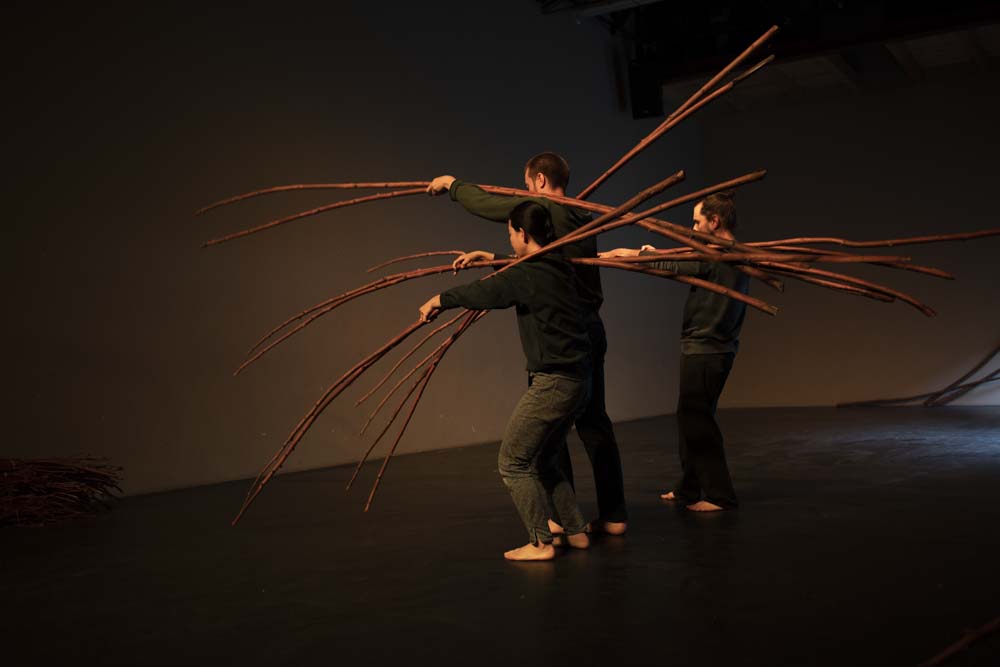
Photo by Miriam Tamayo, all rights reserved
Published 24 June 2025
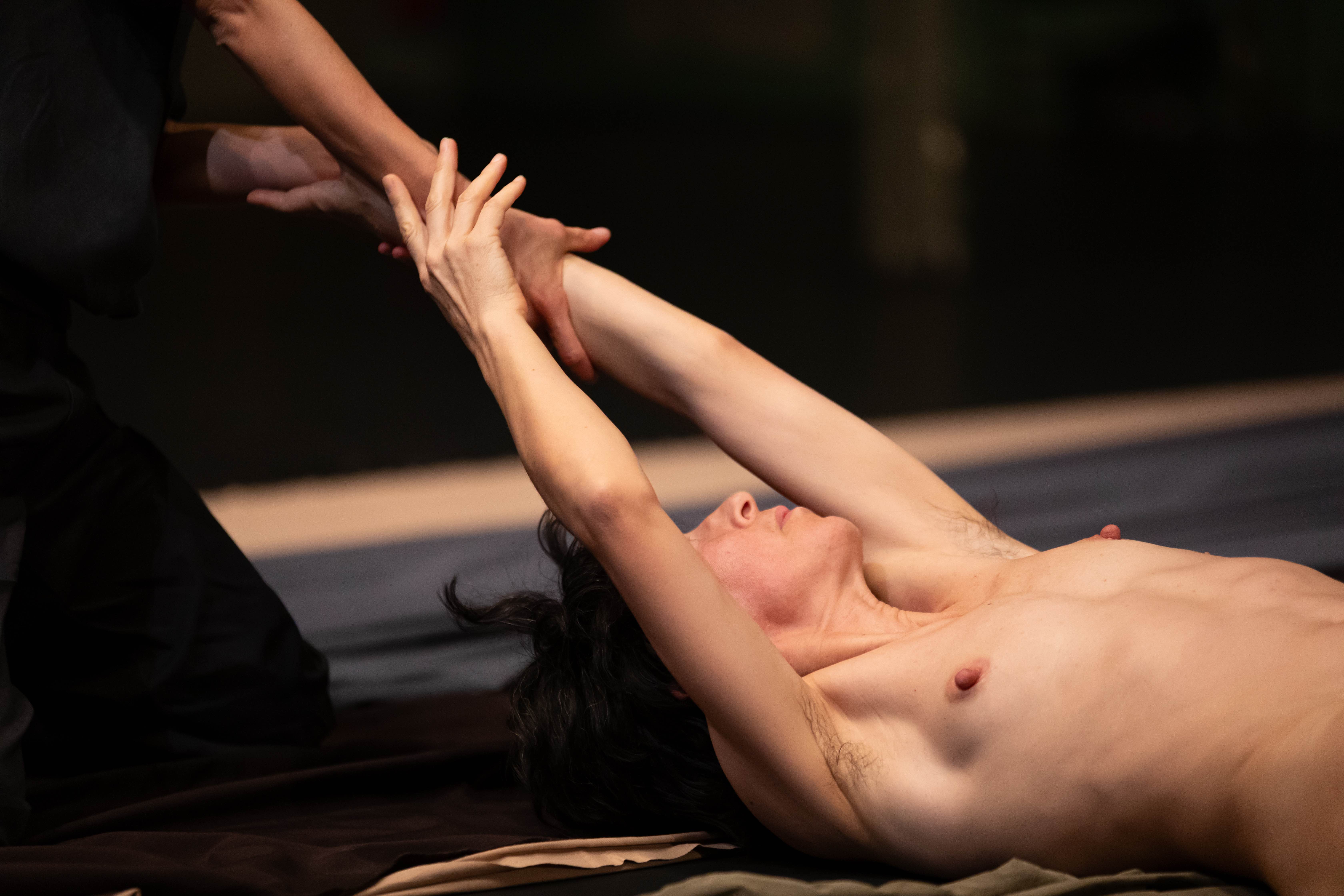
This weekend we warmly invite you to the premiere of Studies on Infinity #3 – Caravaggio, as part of the Wiesenburg Sommerfest.ival 2025.
Caravaggio is the further step of a long-term research into movement materials and their potential to unfold through infinite variations. Focusing on the relationship between self and other/mirror, skin and clothing, dressed and undressed, Caravaggio forms part of an ongoing artistic trajectory that also includes the recent work Close by, So far.
Caravaggio’s paintings combine a realistic observation of the human condition—both physical and emotional—with dramatic lighting. His depictions of religious scenes featuring ordinary people reveal the violence hidden in shadows.
Inspired by these aesthetic resonances, and drawing from movement principles rooted in Zen, somatics, Aikido, and voice work, the choreographic material unfolds beyond the traditional stage — revealing its power within a durational, site-specific performance installation.
Come by and dive with us in a diverse festival program – featuring performances and dance, sensory introductions, installations, films, concerts, and a performative reading. (Full program here)
INFOS
WHEN: 27. & 28. Juni 2025, 18.00 – 20.00 Uhr
On both days at 5:45 PM, there will be a sensorial introduction with Isabelle Schad.
WHERE: Tanzhalle & Werkhalle Wiesenburg: Wiesenstraße 55, 13357 Berlin
CAST & CREDITS
Concept & Choreography: Isabelle Schad / Co-choreography & Dance: Viviana Defazio, Forough Fami, David Kummer, Yen Lee, Arantxa Martinez, Lea Pischke, Claudia Tomasi, Aya Toraiwa, Maja Zimmerlin / Composition & Sound: Damir Simunovic / Light Design: Bruno Pocheron / Voice Coaching: Ignacio Jarquin / PR, Outreach: Elena Basteri / Production Management: Heiko Schramm
Production: Isabelle Schad / Funded by: Senate Department for Culture and Social Cohesion of the State of Berlin / Supported by Wiesen55 e.V.
Photo: Mayra Wallraff, all rights reserved
Published 24 March 2025
Next week from April 2nd to 5th the premiere of Close by, So far – Landscapes of Infinity will be presented as a double bill together with Bodies of Light at the Sophiensæle in Berlin.
Come and see!
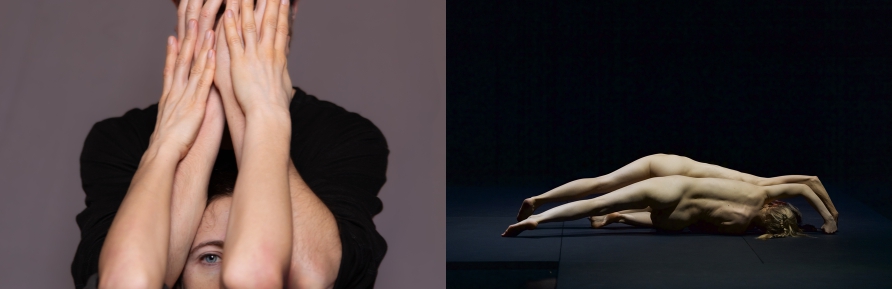
Close by, So far – Landscapes of Infinity is an oscillation between detail and expanse, born out of a longing for contemplation and healing in an age of crisis. The work is inspired by literary works such as The Woman in the Dunes by Kōbō Abe and The Left Hand of Darkness by Ursula K. Le Guin, in which vast landscapes stand as metaphors for a utopian life. Close by, So far – Landscapes of Infinity is both an opposition and a proposal: we insist on our sensibility and our sensual experience. We oppose binary forms of being, seeing and moving: a space of resistance is needed more than ever.
Bodies of Light is based on the solo Solo for Lea (2016) and plays with mutual reflection: two people who follow each other, mirror each other, conceal each other and amplify each other’s contours, rhythms, colours and personal energies. Claudia Tomasi and Yen Lee have each developed their own interpretation of the solo. Now they come together and dance the solo at the same time. At its core, Bodies of Light unfolds at the interface between visual art and dance, between performance and installation, sensual experience and abstraction, and plays with analogies of cubism and Picasso’s drawings from a single stroke.
Credits:
Artistic Direction, Concept, Choreography: Isabelle Schad
Co-Choreography, Dance (Close by, So far): Viviana Defazio, David Kummer, Arantxa Martinez, Alessandra Defazio
Co-Choreography, Dance (Bodies of Light): Claudia Tomasi, Yen Lee
Composition, Sound: Damir Simunovic
Light Design: Bruno Pocheron
Costume Collaboration (Close by, So far): likabari, Arantxa Martinez
Advisor Relaxed Performance: Leo Naomi Baur
Social Media: Rike Nölting
PR, Mediation: Elena Basteri
Production Management: Heiko Schramm
A production by Isabelle Schad in co-production with Sophiensæle. Funded by the Senate Department for Culture and Social Cohesion Berlin. Supported by Wiesen55 e.V.
Photo 1: Close by, So far – Landscapes of Infinity, Mayra Wallraff, all rights reserved
Photo 2: Bodies of Light, Dieter Hartwig, all rights reserved