Studies on Infinity #2 Nudity and Landscape

Studies on Infinity #2 – Nudity and Landscape  

Mit Studies on Infinity #2 – Nudity and Landscape setzt Isabelle Schad ihre langjährige Forschung zu Bewegungsmaterialitäten und deren Potenzial, in ihren unendlichen Variationen und Verkettungen erforscht zu werden, fort. Die Untersuchung zu Nudity and Landscape als Beziehung zwischen Selbst und Gruppe, zwischen Körperlichkeit, Haut und Landschaft begann mit der Arbeit Pieces and Elements in 2016. Die Kontinuität der Haut von einem Körper zum anderen entspricht einem Verständnis des Selbst, welches sich durch Andere ebenso fortsetzt und spiegelt wie durch unsere Umgebung. Es ist ein energetisches Prinzip, das dem Gesetz der Anziehung folgt: Ein Spiegel reflektiert zurück, schwingt und zieht an, was ausgesandt wird und umgekehrt.

Ausgehend von im Zen verankerten Prinzipien, von Somatik, Qi Gong, Aikido und Atemtechniken, wird das choreografische Material losgelöst vom klassischen Bühnenkontext präsentiert und entfaltet seine Kraft in Form einer installativen Dauerperformance. Einzelne Sequenzen und Motive werden extrahiert, neu kombiniert und -kreiert, um Details wie Miniaturen des Flows erscheinen zu lassen. Skulpturen und Formen erscheinen und lösen sich wieder, und laden zum Eintauchen in die sinnliche Wahrnehmung im eigenen Erleben ein. Die Besucher*innen sind eingeladen, einen Raum zu bewohnen, in dem theatrale Konventionen verschwimmen, um in eine zeitlose Erfahrung einzutauchen.

With Studies on Infinity #2 – Nudity and Landscape Isabelle Schad continues her long-term research into movement materials and their potential for infinite variation. Schad’s investigation into nudity and landscape as a relationship between self and group, skin and environment began with her work Pieces and Elements (2016). The continuation of skin from one body to another corresponds to an understanding of the self as extending/mirroring infinitely through others and the environment. It is an energetic principle which follows the law of attraction: a mirror reflects back, vibrates and attracts what is sent out. We are all infinitely reflecting and being reflected.

Drawing on principles anchored in Zen, somatics, qi gong, aikido and breathing techniques, the choreographic material is detached from a classical stage context and unfolds its power as a durational installation performance. Individual sequences from existing pieces are selected, recombined or created anew, facilitating close-up miniatures of flow. In this process the sensorially perceptible qualities of movement are worked like sculpture. The audience is invited to inhabit a space where theatrical conventions are blurred, and to immerse themselves in a timeless experience.

Konzept & Choreografie: Isabelle Schad / Co-Choreografie & Tanz: Johanna Ackva, Viviana Defazio, Veronika Heisig, David Kummer, Yen Lee, Manuel Lindner, Jan Lorys, Lea Pischke, Arantxa Martinez, Aya Toraiwa, Maja Zimmerlin / Komposition & Sound: Damir Simunovic / Lichtdesign: Bruno Pocheron / Stimmarbeit: Ignacio Jarquin / Kommunikation: Elena Basteri / Produktionsleitung: Heiko Schramm

Produktion: Isabelle Schad / Gefördert durch: Senatsverwaltung für Kultur und Gesellschaftlichen Zusammenhalt des Landes Berlin / Unterstützt durch Wiesen55 e.V.

All pics: Dieter Hartwig, all rights reserved


Studies on Infinity #2 – Nudity and Landscape  

von Isabelle Schad / Good Work Productions

Das Bild, das mir noch lange in Erinnerung bleiben wird, fühlt sich an wie ein Blick in die Weite einer Hügellandschaft im Lichte der Morgenstunde. 

Ich war jedoch weder auf einer frühen Wanderschaft, noch war ich in einem Museum, um mir William Turners Aquarelle oder Claude Monets Landschaftsimpressionen anzuschauen. Nein, ich war in der Wiesenburg, in Wedding, dem nicht leicht zu findenden, teilweise zugewachsenem Studio von Isabelle Schad, der – aus meiner Sicht – wichtigsten Choreographin Deutschlands. Ich suchte ihr Berliner Forschungslabor um die neueste Gruppenarbeit „Nudity and Landscape aus der Serie Studies on Infinity #2“ – zu sehen. Das die Studien zur Unendlichkeit durchnummeriert werden müssen, erzeugte bei mir schon vorweg ein Lächeln. Und was Nacktheit mit Landschaft zu tun haben könnte, ist die Frage, mit der wir uns vor dem leeren weißen Tanzboden ihrer Studiobühne einrichteten.

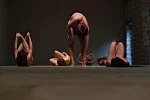
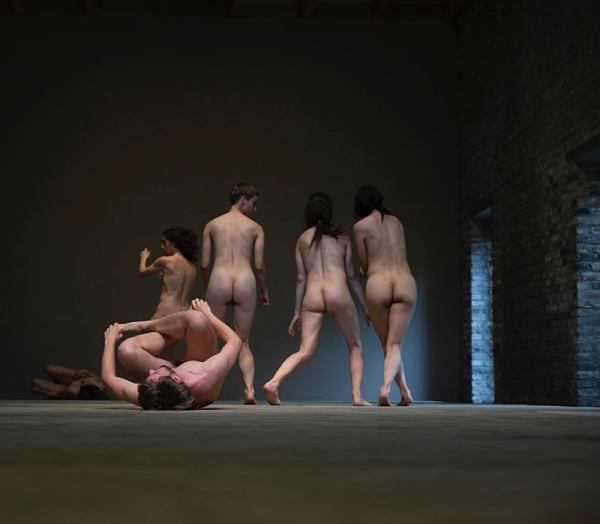
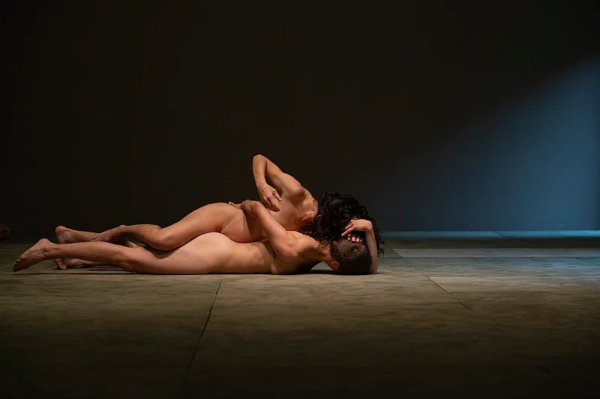
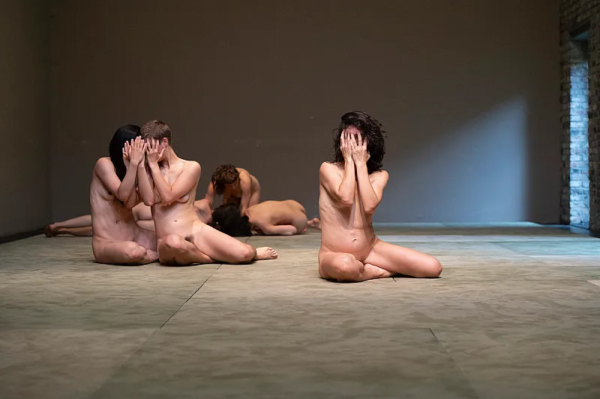
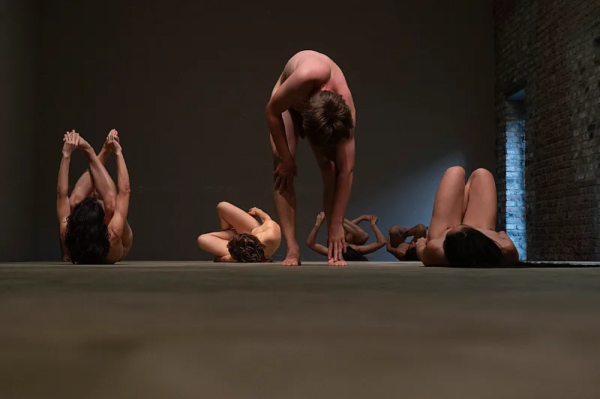
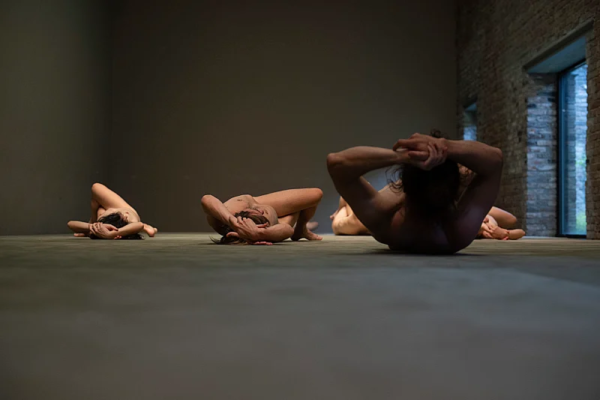
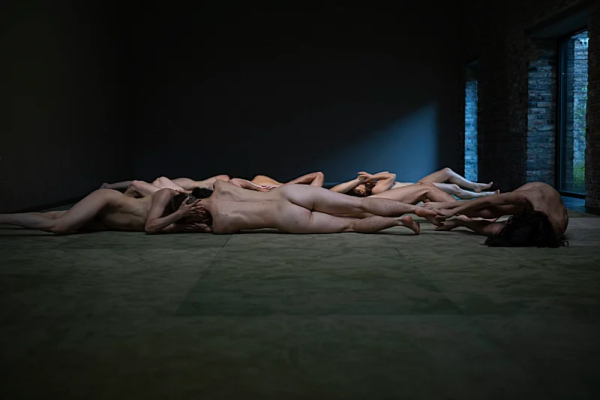
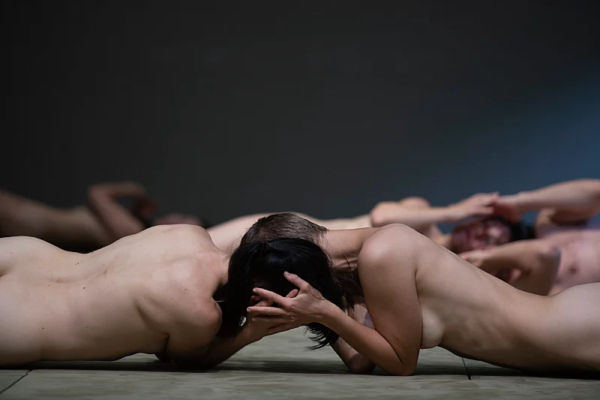
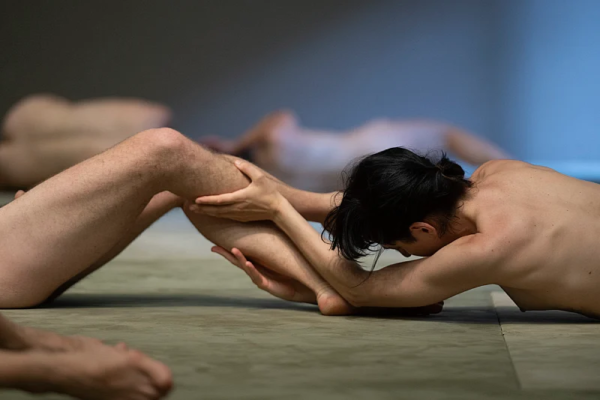
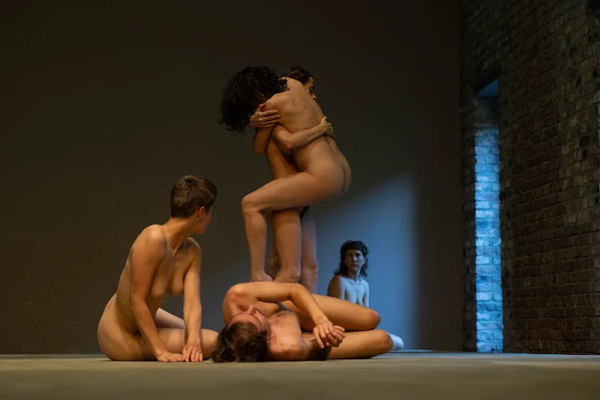
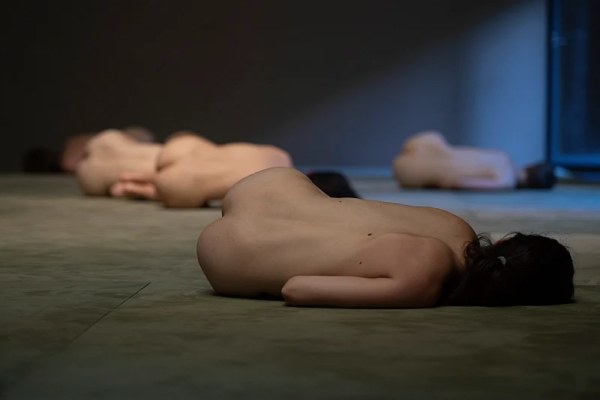
Schon der Einstieg ist so simpel wie magisch. Nach und nach, aus dem Publikum kommend, schlüpfen die Performerinnen an der Bühnenkante ohne viel Tamtam aus ihrer Schort und ihrem T-Shirt und schmiegen sich am hinteren Ende der Bühne ganz breit auf – oder besser in – den Tanzboden. Boden und Körper verschmelzen scheinbar, werden Eins. Tatsächlich entstehen mit dem vierten oder fünften Körper das Bild und das Gefühl einer Landschaft. Nah und fern, darüber und darunter, vor und hinter, alles aus Haar und Haut. Eine Landschaft die sich anfangs kaum merklich auf das Publikum zu bewegt. Körper, die einander begegnen und so zu Hügeln und Gebirgen werden, sich auftürmen und im gleichen Moment Täler formen, um dann doch wieder im Ganzen zu verschwinden. 

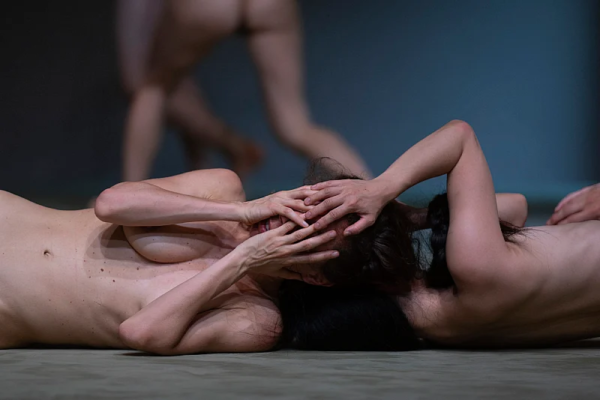
Dass erzeugt eine Art Vogelperspektive, einen weiten-, einen Über-Blick, der uns beruhigt und uns Orientierung verspricht. Gleichzeitig ist da die Nacktheit, die Haut, die intime Nähe. Wir zoomen auf Details, als wären wir ein Moskito, der nur Zentimeter über der Haut jede Stelle des Körpers genau beobachtet. 

Das ist es, was mich an der ewig forschenden Isabelle Schad so begeistert. Sie befragt ihren Körper und den ihrer Tänzer*innen immer wieder auf neue Weise und legt Perspektiven und Gegensätze frei die überraschend, manchmal unerklärlich aber immer auch stimmig, auf eine einfache (körperliche) Art „wahr“ sind.

Was dann noch passiert in dem Stück soll nicht gespoilert werden, aber für mich hat es sich so angefühlt, als wäre auch ich Teil der „Landscape“, Teil der Gruppe und meine Haut spürte schon wie sich die weiche Decke, die uns alle …

Bei den Studies on Infinity #3, #4, #5 bin ich sicher wieder in der Wiesenburg.

Guido Reimitz
Guido Reimitz ist seit nunmehr über 30 Jahren eng mit der internationalen zeitgenössischen Tanz- & Performanceszene vernetzt und kooperiert mit KünstlerInnen, Compagnies, EU-Initiativen und Festivals sowie Universitäten & Akademien im In- und Ausland.1996 gründete er danceWEB, das bis heute weltweit führende Stipendien-Programm im zeitgenössischen Tanz. Mit weiterführenden Initiativen, wie der internationalen Koproduktionsplattform  European CoDaCo Fund, der Young Choreographers‘ Series [8:tension] oder afterwords kreierte er als ImPulsTanz-CoDirektor Formate, die innovative “Räume” für Produktion, Präsentation, Austausch, Vernetzung und Diskurs eröffneten. 
2014 bis heute begleitet er die MixedAbled-Tanz und Performanceszene bei ihrer Professionalisierung und ist als Koordinator für das inklusive Kunstprojekt MELLOW YELLOW tätig. 

.
English:

Studies on Infinity #2 – Nudity and Landscape
by Isabelle Schad / Good Work Productions

The image that will stay with me for a long time feels like a view of the expanse of a hilly landscape in the light of dawn.
However, I was not on an early hike, nor was I in a museum looking at William Turner’s watercolours or Claude Monet’s landscape impressions. No, I was in the Wiesenburg, in Wedding, the not-easy-to -ind, partly overgrown studio of Isabelle Schad, the – in my opinion – most important choreographer in Germany. I was looking for her Berlin research laboratory to see the latest group work ‘Nudity and Landscape’ from the series ‘Studies on Infinity #2’. The fact that the studies on infinity have to be numbered made me smile in advance. And what nudity could have to do with landscape is the question we asked ourselves in front of the empty white dance floor of her studio stage.

Even the introduction is as simple as it is magical. One by one, coming from the audience, the performers at the edge of the stage slip out of their shorts and T-shirts without much fanfare and nestle broadly onto – or rather into – the dance floor at the back of the stage. Floor and body seem to merge, become one. In fact, the fourth or fifth body creates the image and feeling of a landscape. Near and far, above and below, in front and behind, all made of hair and skin. A landscape that initially moves towards the audience almost imperceptibly. Bodies that meet and thus become hills and mountains, pile up and form valleys at the same moment, only to disappear again into the whole.

This creates a kind of bird’s eye view, a wide view, an overview that reassures us and promises us orientation. At the same time, there is the nakedness, the skin, the intimate closeness. We zoom in on details as if we were a mosquito observing every part of the body just centimetres above the skin.
That’s what fascinates me so much about the eternally enquiring Isabelle Schad. She constantly questions her body and that of her dancers in new ways and uncovers perspectives and contrasts that are surprising, sometimes inexplicable but always coherent and ‘true’ in a simple (physical) way.
I don’t want to spoil what else happens in the piece, but for me it felt like I was also part of the ‘landscape’, part of the group, and my skin could already feel the soft blanket that covers us all …

I’ll certainly be back at the Wiesenburg for Studies on Infinity #3, #4, #5.

Guido Reimitz
Guido Reimitz has been closely networked with the international contemporary dance and performance scene for over 30 years now and cooperates with artists, companies, EU initiatives and festivals as well as universities and academies at home and abroad. In 1996, he founded danceWEB, the world’s leading scholarship programme in contemporary dance to this day. With further initiatives such as the international co-production platform European CoDaCo Fund, the Young Choreographers’ Series [8:tension] or afterwords, he created formats as ImPulsTanz CoDirector that opened up innovative “spaces” for production, presentation, exchange, networking and discourse.
From 2014 to the present day, he has supported the mixed-abled dance and performance scene in its professionalisation and works as coordinator for the inclusive art project MELLOW YELLOW.

The Body as an Infinite Landscape

Nudity, contagion, landscape: at Uferstudios, Isabelle Schad presents Studies on Infinity – Nudity and Landscape, a two-hour performance installation in which the audience is invited to move and sit freely within the space. A rigorous piece that stretches stage time until it coincides with each spectator’s own experience of it.

Studies on Infinity – Nudity and Landscape is the latest chapter in a choreographic enquiry Isabelle Schad has pursued for years, treating movement as an infinitely variable material. The work continues her investigation into nudity and landscape as a relationship between self and group, skin and environment, begun with Pieces and Elements (2016): an almost energetic principle, whereby the body reflects and is reflected, in a continuum that passes from one dancer’s skin to another’s, until it dissolves into the surrounding space.

A thirty-minute sensory introduction precedes the piece, in which Schad herself guides the audience through exercises drawn from qi gong, aikido and breathing techniques. It is she who lays out the implicit rules of the experience: the performance/installation is to be inhabited rather than watched; one may stand, move, shift position around the large pale tatami that fills the performance space, so long as one stays comfortable, and cushions are placed there precisely to signal that the stillness of a conventional audience is neither required nor, perhaps, even desired.

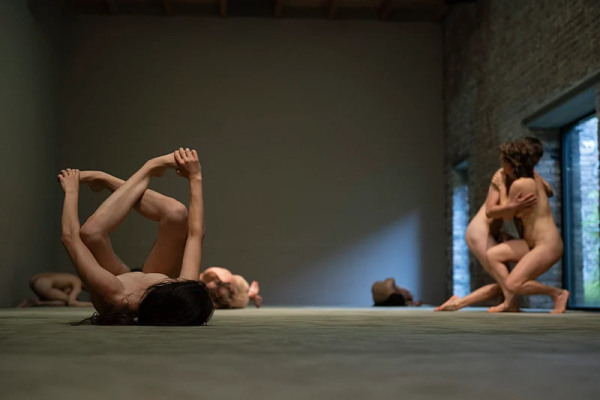
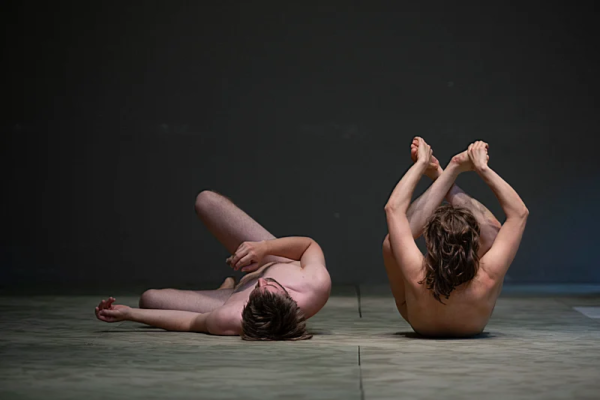
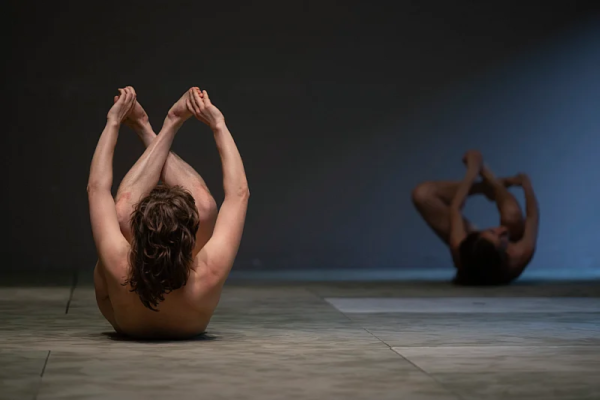
The tatami is also the first landscape we encounter: a nude male body, lying on his side with his back to the audience, one leg extended and one bent, opens the sequence with a barely perceptible movement of the spine rising and falling. Full nudity is never absent from the tatami, though it isn’t constant for every individual performer: those who leave the space get dressed, those who re-enter shortly after remain nude – with no wings to retreat to, these transitions happen in full view, functioning as a further gesture within the action rather than a pause from it. Skin exposed as scenic material, on a par with the tatami, the sound, the light. From there the choreographic material multiplies as if by contagion: other bodies join in, alternating between solos that become duets, then small groups, in a work that handles the sensory qualities of gesture – crawling, rolling, reaching for one another’s feet in a twist that binds the bodies together – much like sculpture treats form.

The principle of contagion here is not merely a choreographic metaphor: Schad’s practice is also rooted in Body-Mind Centering and in the embryological ideas of Bonnie Bainbridge Cohen (movement artist, educator and therapist), according to which the body, in its earliest weeks of formation, develops “from and within its own space” before it is even connected to the mother. It is an idea of the cell as a unit that organises and reorganises itself in relation to others. By letting solos dissolve into duets and duets into small groups, Schad builds not a composition but a self-generating organism.

Gradually the action lifts off the ground: the dancers rise to their feet, cross the edges of the tatami, run and skip beyond the perimeter marked out by the mats, let their hair loose, echo in their spines the same undulating movement seen at the opening, now amplified by verticality.

There is something, in this gradual expansion of the space occupied by the bodies, that recalls Gilles Clément’s notion of the “third landscape”: those undecided margins, like the edge of a wood, the verge of a road or a derelict plot, where humans stop designing and let the living beings that inhabit them determine their own evolution. As the bodies cross the boundaries of the tatami, they seem to claim the same status: no longer choreography traced onto a designated surface, but an organism expanding into the margins of the room, into an undecided space that the staging itself stops trying to control.

Towards the end, the material intensifies further: Damir Simunovic’s score builds, the bodies rise up to full verticality, then exit sideways, leaving the stage to a final collective surge, almost a choral thrust, before the blackout. What strikes most, in this closing surge as throughout the piece, is the quality of mutual listening between the eleven performers: they move with the complicity of those following the rules of a game only they know, attentive to one another more than to any fixed score, able to fall into unison or veer off in a new direction without ever revealing a hint of hierarchy or command.

For all its exposed, stretched-out format, the performance never loses its sense of direction over its two hours. Between the heat of that August evening and a packed house, moving with the freedom the artist herself had encouraged wasn’t always easy, though that, too, was a sign of just how gripped the audience had been, filling every corner of the room. What remains is an intense experience well worth living through: an invitation to lose oneself in a time that is “out of joint”, where performance and landscape, individual and group, keep mirroring one another, endlessly.

Elisa Frasson, published August 26 in: teatro.persinsala.it/